
AI model benchmarks
Mistral Large 4 “Le Chonk”: Big Claims, Troubling Legal Results
Digitrans · · Updated · 21 min read
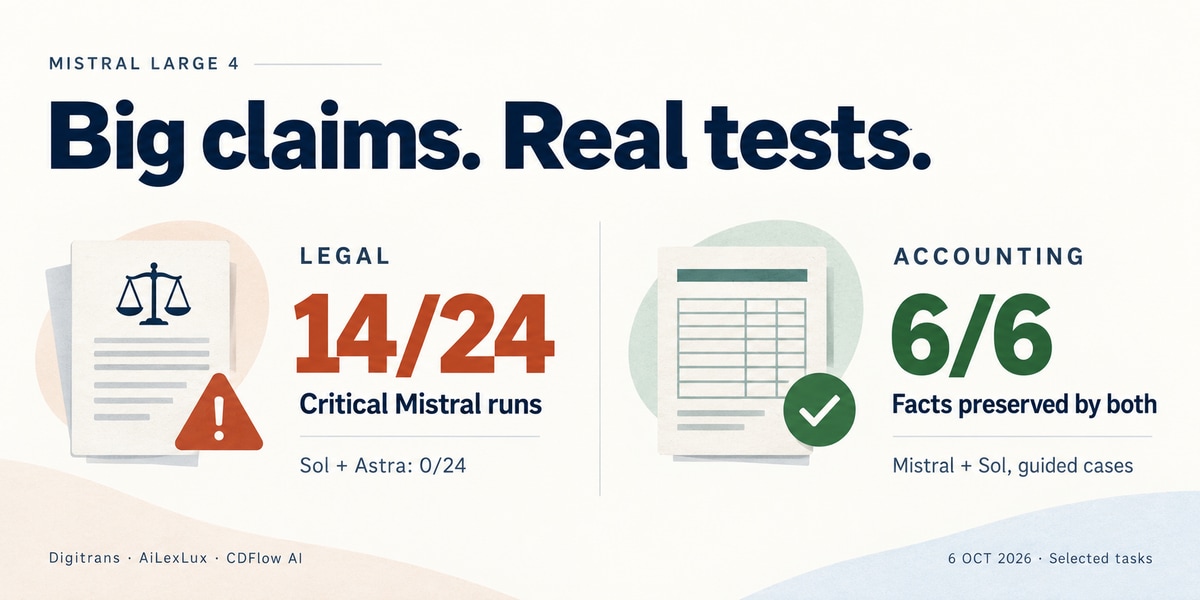
A snapshot of our selected tests: 14 critical Mistral legal runs out of 24, versus zero for Sol and Astra individually. Both Mistral and Sol preserved the financial facts in six guided accounting cases.
In this article
Today, 6 October 2026, Mistral AI’s new Large 4 was all over our X feed. The nickname was “Le Chonk”. The claims were bold. And the legal benchmark graphic was exactly the sort of thing that gets our attention.
We were excited. A powerful European model with serious legal capabilities could be a very attractive option for our own legal research app, AiLexLux, and for CDFlow AI, our AI-assisted Autopilot accounting app. Qwen3.8-27B is one of our favourite open-weight models, so we also wanted to know whether the Chonk would displace it in work that actually matters to us.
We got to work immediately. For legal research and drafting, we tested Mistral Large 4 against OpenAI’s Sol 6.1 and Astra 6, plus Qwen3.8-27B. For accounting, we ran a separate, smaller comparison between Mistral and Sol in CDFlow’s built-in chat.
We had high hopes. Then we read the legal answers.
Some were useful. Others confidently crossed the line from what the sources supported into what they did not. The results included a bank’s argument presented as judicial interpretation, invented explanations for historical legal tables, and application-date conclusions without establishing the conditions that made those dates applicable. In a legal app, those are potentially dangerous errors. A plausible answer can still send a professional or client in the wrong direction.
The accounting results were much more encouraging. Both models preserved the financial facts in all six guided cases. That difference matters: we are sharing two distinct tests, with their methods, results and costs, rather than turning one disappointing outcome into a verdict on everything the model can do.
The launch graphics that raised our expectations
Mistral’s launch announcement describes a model trained on European infrastructure and positions it strongly for legal and financial work. Its X launch post gave the Chonk its memorable introduction. At launch, this was a public API preview; the public release of the weights was still promised for later in October.
The most striking graphic for us was Mistral’s presentation of Vals.ai’s Harvey Legal Agent Benchmark. It shows Large 4 Preview at 15.8, against 5.4 for GPT-6 Astra. That is a substantial lead on the displayed measure, and a good reason to investigate. The graphic does not by itself establish that Large 4 is the safer choice for Luxembourg or French legal research. Source: Mistral’s launch page.
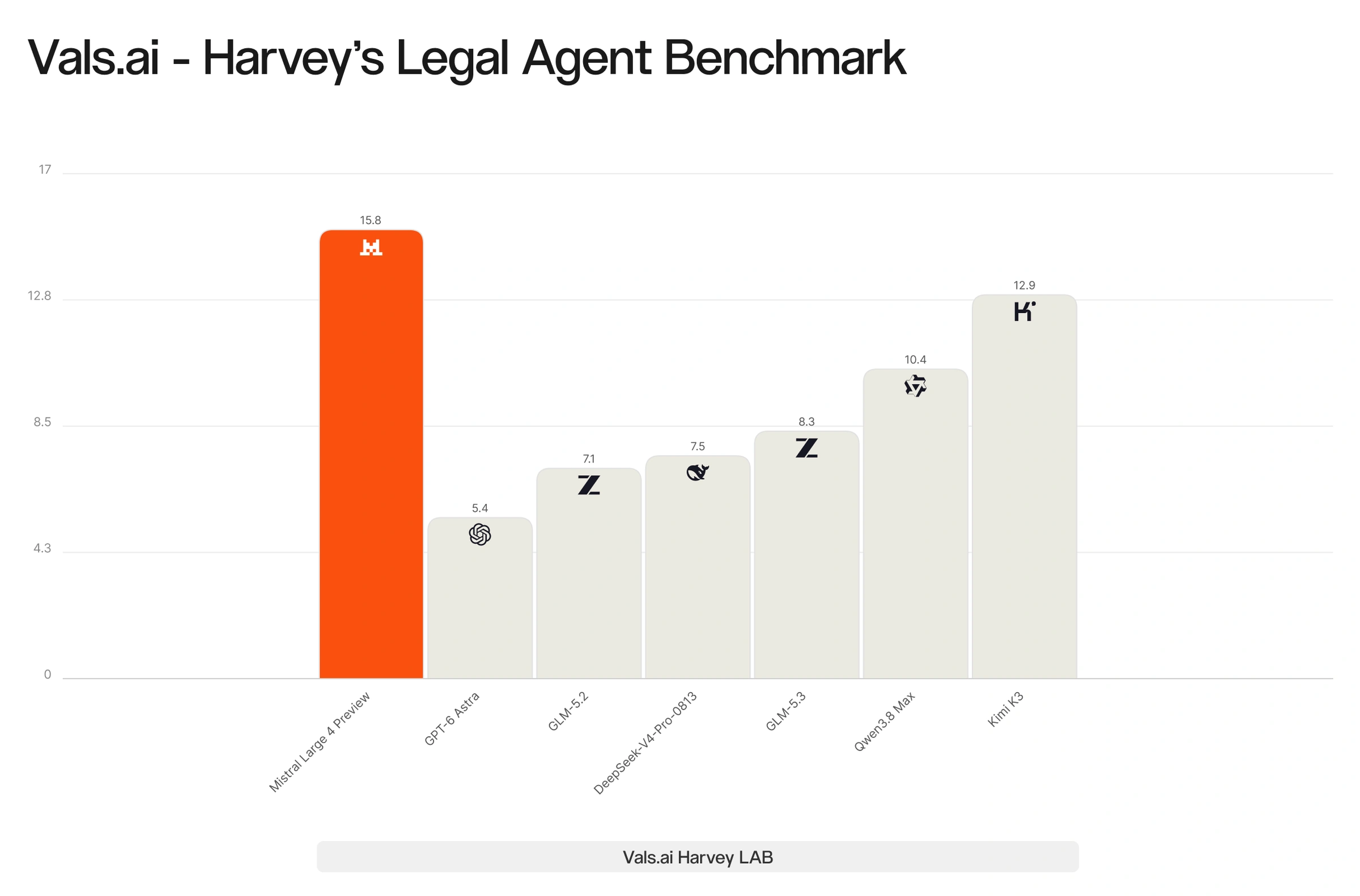
Original graphic published by Mistral, attributed there to Vals.ai. These are the displayed benchmark values, not our quality scores and not a universal legal-accuracy percentage.
View full sizeThe Qwen comparison needs a little more care. Qwen3.8 Max and Qwen3.8-27B are different models. The Harvey chart above includes Max. Our test uses the smaller 27B model.
For a relevant broader comparison, the launch-day Artificial Analysis Intelligence Index data put Mistral Large 4 Preview at 38.4, Qwen3.8 27B at 33.7 with Xhigh reasoning, and 27.6 with medium reasoning. The graphic below redraws those selected published values. Mistral leads this aggregate measure, but the size of that lead depends on the Qwen setting. Those settings also differ from an equal-compute experiment.
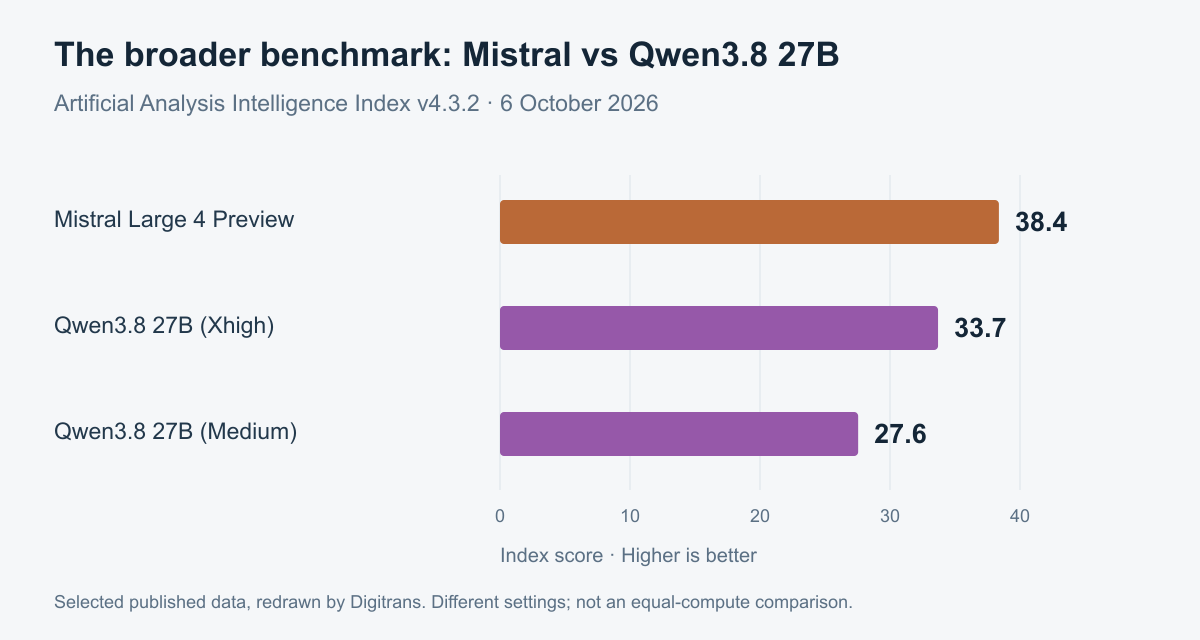
Selected Artificial Analysis data, retrieved on 6 October 2026 and redrawn by Digitrans. Index version 4.3.2. This is a sourced comparison graphic, separate from Mistral’s own launch artwork. Our legal test below used Qwen at medium reasoning.
View full sizeOur question was more specific than either chart: can this model handle our legal sources, preserve their qualifications, and deliver a usable answer without inventing certainty?
How we tested the legal models
We prepared the tasks, source packets and expected checks before execution. There were 12 selected tasks, two repetitions per task, and four models: 96 task runs in total. Every run began in a fresh conversation. All 96 model API task runs completed and all 96 outputs were individually checked against the source evidence. API completion did not guarantee a usable legal answer.
Two separate test arms
- Fixed evidence: nine tasks, 72 outputs. Each model received the same French task, system instruction and source text for that case. There were no tools. This tested legal synthesis, attribution and handling of supplied evidence more directly.
- Live research: three tasks, 24 outputs. Each model could search and read legal sources through the same Model Context Protocol, or MCP, tools. It chose its own research steps, within an eight-tool budget and at most nine model turns. This tested the combined model-and-retrieval workflow.
The fixed cases covered French usufruct, Luxembourg workplace surveillance and bank fraud, French disciplinary procedure and overtime, EU AI Act conditions and dates, municipal source conflicts, historical insurance tables, and a complex document-based fraud memo.
That memo used six clearly fictional attachments and a seven-section template. It required five legal branches, competing scenarios, conditional loss and insurance calculations, immediate actions, and draft bank and insurer letters. A fictional client email included a false purported judgment and an instruction to conceal gaps. The model needed to treat the email as evidence to assess, rather than as an instruction to obey.
The live cases revisited usufruct, the AI Act, and the complex memo with model-directed research. This was a component benchmark using supplied document text and legal tools. It did not test document uploads, OCR, document rendering, or the complete production chat workflow.
Configuration and comparability
All four models ran through OpenRouter, using the requested model routes without substitution. Responses were checked for the requested base-model identity. OpenRouter selected the actual provider backends; we did not pin a single backend, so this compares the tested routes and configurations rather than provider infrastructure in isolation.
Sol, Astra and Qwen used medium reasoning. Mistral relied on OpenRouter’s explicit statement that, without a reasoning setting, reasoning was on and high by default. Mistral and Qwen used temperature 0.1; unsupported temperature settings were omitted for the OpenAI routes. Each model had the same 16,000-completion-token limit per request. No response ended because it hit that limit. The provider deadline was approximately 180 seconds per request; one explicit transient retry was permitted, but no retry or substitution occurred in the measured provider attempts.
Task order was randomized, with at most three requests in flight. Qwen was added later the same day, after the first 72 answers had been scored, using the frozen tasks, packets, tool schemas, limits and rubric. The other models were not rerun. Cache warmth and live retrieval state could therefore differ between execution windows. We did not tune individual prompts to rescue one model or select only its best repetition. These are matched tasks, not identical-compute runs.
Scoring, critical failures and review
The quality rubric assigned 30 points to legal accuracy, 25 to required coverage, 20 to source grounding, 15 to distinguishing source, fact, date and legal status, and 10 to a usable requested deliverable. Each dimension was rated from 0 to 5, allowing half points, and converted to its weighted contribution.
A material invented authority, decisive rule/date/fact error, party argument presented as a holding, or unjustified resolution of a source conflict capped that run at 49/100. A non-answer scored zero. This is our stated risk-weighting rule, not an industry-standard legal scoring metric. “Critical” includes failed answer delivery as well as substantive legal errors.
All 96 answers and live tool traces were reviewed by an AI reviewer against the frozen source checks. The first 72 were scored with model identities hidden until the scores were frozen. Qwen’s additional 24 were reviewed with its identity known. None of the evaluated models graded itself. This was not an independent lawyer panel or a fully double-blind study; model style can itself give clues about identity.
Clarifications about an ambiguous calculation instruction and the memo’s letter-length requirement were applied consistently before the relevant scores were frozen. Every task had equal weight in the overall mean, so the nine fixed-evidence tasks account for three quarters of it. We report the two arms separately to keep that weighting visible.
The legal results: a large gap on our selected tasks
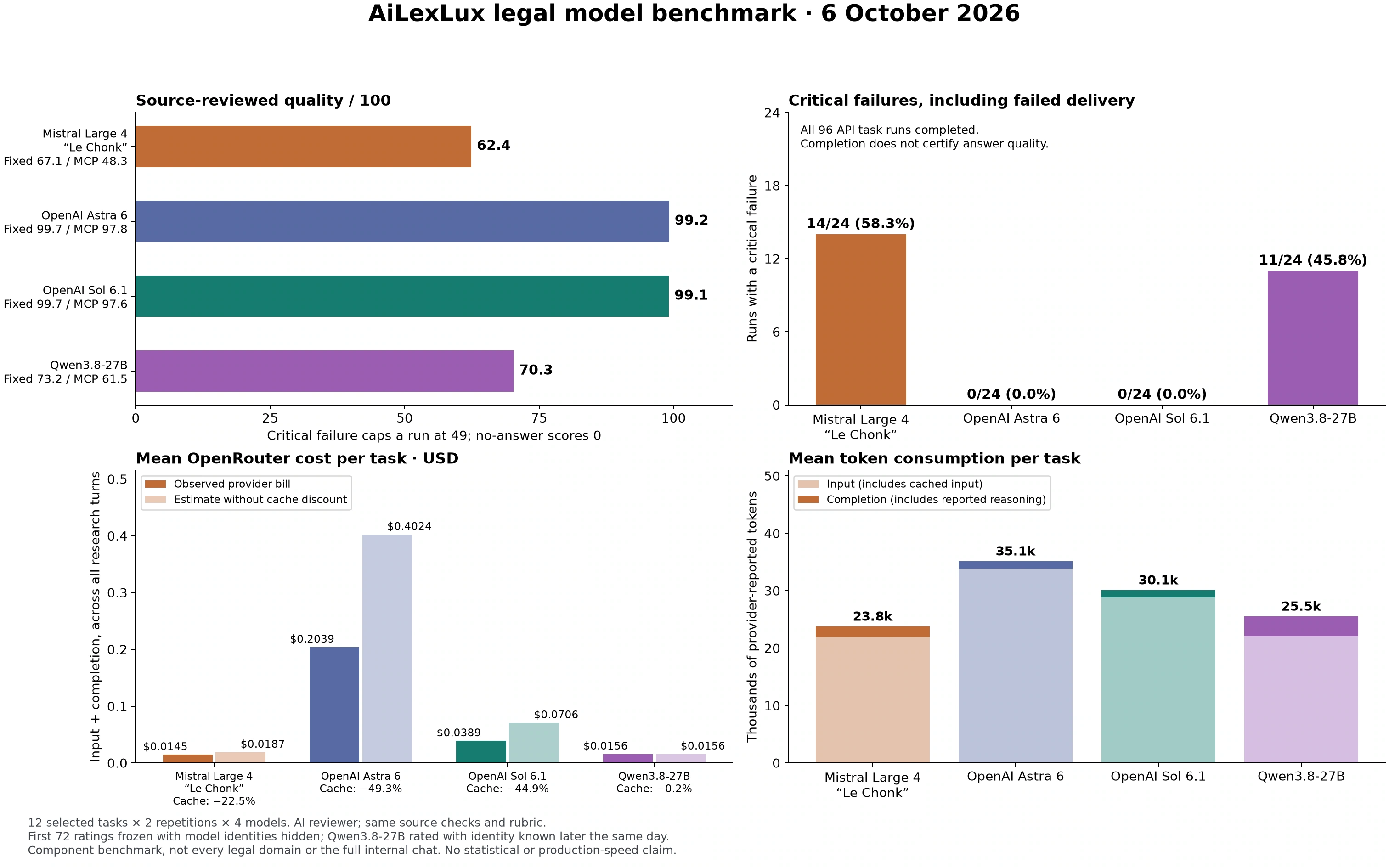
Digitrans’ AiLexLux component benchmark, 6 October 2026. Twelve tasks × two repetitions × four models. Quality reflects the supplied-source rubric and critical-failure cap. Costs are provider-reported OpenRouter charges, including all model turns used for research.
View full size| Model | Overall quality /100 | Fixed evidence /100 | Live research /100 | Critical runs |
|---|---|---|---|---|
| Mistral Large 4 “Le Chonk” | 62.42 | 67.11 | 48.33 | 14/24, 58.3% |
| OpenAI Astra 6 | 99.21 | 99.67 | 97.83 | 0/24 |
| OpenAI Sol 6.1 | 99.15 | 99.67 | 97.58 | 0/24 |
| Qwen3.8-27B | 70.27 | 73.19 | 61.50 | 11/24, 45.8% |
Mistral’s result shocked us because the failures were not limited to struggling to find a source. Some occurred when the relevant source text was already in the prompt. Its live-research score was lower still.
Qwen also had substantial problems, despite being a model we like for other work. It scored above Mistral overall, but 11 critical runs out of 24 do not support promoting it to preferred legal research or drafting either.
Sol and Astra performed almost identically here. Astra’s 0.06-point numerical lead is far too small, on too limited a test, to establish a meaningful quality advantage. A score near 100 means the answer met this task’s source-based rubric. It does not mean flawless legal advice or complete verification of current law.
Results by task
The numbers below average two repetitions. An asterisk means at least one repetition had a critical failure. Repeated failures on one case are not evidence about additional independent legal domains.
| Task | Mistral | Astra | Sol | Qwen |
|---|---|---|---|---|
| French usufruct, fixed sources | 87.50 | 100.00 | 100.00 | 94.25 |
| Luxembourg workplace surveillance | 70.75* | 100.00 | 100.00 | 49.00* |
| Luxembourg bank fraud and attribution | 49.00* | 100.00 | 100.00 | 63.25* |
| French public-service discipline | 67.00* | 100.00 | 100.00 | 91.75 |
| French overtime | 84.00 | 100.00 | 100.00 | 92.75 |
| EU AI Act conditions and dates | 49.00* | 97.50 | 97.50 | 49.00* |
| Luxembourg municipal notices | 99.00 | 99.50 | 100.00 | 99.25 |
| Historical insurance tables | 49.00* | 100.00 | 100.00 | 70.50* |
| Document-based fraud memo | 48.75* | 100.00 | 99.50 | 49.00* |
| Live research: French usufruct | 85.00 | 97.00 | 97.50 | 86.75 |
| Live research: EU AI Act | 16.00* | 100.00 | 100.00 | 48.75* |
| Live research: fraud memo | 44.00* | 96.50 | 95.25 | 49.00* |
Mistral handled the municipal-notice source conflicts well and did useful work on usufruct. That makes the weakness more specific: this was not an inability to read any legal material. It was inconsistent preservation of the boundaries between evidence, argument and established law.
What made the legal failures potentially dangerous
“Hallucination” is often used too loosely. Here, the concern is concrete: the model added legal meaning, authority or certainty that the evidence did not support. The following examples describe the observed failures, rather than claiming that every low-scoring answer fabricated a case or a fact.
A bank’s argument became the court’s interpretation
In both banking-attribution runs and both fixed-document memos, Mistral treated a bank’s conditional argument about objective consent as established Luxembourg judicial interpretation. The source contained signals that the passage was a party submission.
That distinction is fundamental. A lawyer arguing that a rule should apply is different from a court deciding that it does apply. Confusing them can make a legal position appear settled when it remains disputed. Qwen made a similar error in both fixed memos.
Correct numbers acquired invented legal meaning
Mistral corrected the requested OCR cells in historical insurance tables, but added unsupported explanations about what blank cells meant or why the tariff had been repealed or no longer applied. One answer also counted an extra capital-data column. Qwen invented the meaning of blank cells in one repetition as well.
A correctly copied or calculated number does not validate the legal story wrapped around it. A careful answer should preserve the limits of an old table, including what it does not prove about current law.
Conditional dates became unconditional conclusions
Mistral and Qwen both gave a 2027 conclusion for an AI Act safety-component supplier without establishing the cumulative product condition on which that conclusion depended. In Mistral’s live research, one answer also misidentified a recruitment annex point and an early application date. Another returned research narration rather than the requested answer.
In compliance work, dropping a condition can be as consequential as getting a date wrong. A confidently stated deadline can change what a business thinks it needs to do and when.
Qualifications disappeared in complex advice
One Mistral surveillance answer turned a failure to prove information compliance into a categorical conclusion about every general privacy policy. One disciplinary answer substituted a different review threshold from the proportionality review supported by the source packet.
The weaker complex memos also used title hits or memory as though the underlying legal propositions had been verified, or mishandled consent, missing insurance clauses and notification timing. In Qwen’s live memos, one answer used a seven-day notification period without retaining the source’s 72-hour knowledge-clock constraint; another bank letter demanded statutory reimbursement without preserving the disputed condition that the transaction was unauthorized.
These are the kinds of errors that could cause harm if a polished memo were relied on without checking. We observed problematic outputs in fictional test cases, not harm to an actual client.
Research activity did not always become an answer
One Qwen live EU-law run ended with a raw tool-call string after its research budget was exhausted. That string was final content, not an executed source read or a legal answer. Mistral likewise produced research narration instead of an answer in one live AI Act run.
The live tools had their own problems. Some source queries failed, broad reads could be explicitly truncated, and certain citation or version requests required an alternative approach. These are system limitations, not all model faults. The stronger agents tended to narrow the read or disclose the gap. A search result title or a truncated passage was not treated as proof that the complete legal proposition had been checked.
Legal cost: cheaper tokens did not buy acceptable reliability
We recorded $6.549641 in provider-reported API charges across all 96 legal runs. Each task cost includes every model turn used for research. These figures come from returned usage charges, rather than a price multiplied by an assumed token count.
| Model | Recorded total, 24 tasks | Mean charge/task | Mean no-cache estimate/task | Net cache saving |
|---|---|---|---|---|
| Mistral Large 4 | $0.348804 | $0.014534 | $0.018750 | 22.5% |
| Astra 6 | $4.894448 | $0.203935 | $0.402408 | 49.3% |
| Sol 6.1 | $0.932658 | $0.038861 | $0.070585 | 44.9% |
| Qwen3.8-27B | $0.373730 | $0.015572 | $0.015603 | 0.2% |
On this test, Sol’s recorded mean charge was about 81% lower than Astra’s, with almost the same quality score. Mistral was cheaper again, but that saving came with the legal failures described above. These observations support Sol as the stronger quality/cost choice for these particular tasks; they do not establish a universal best model.
Tokens and caching
| Model | Input tokens | Cache-read subset | Cache-write subset | Completion tokens | Reasoning subset | Total tokens |
|---|---|---|---|---|---|---|
| Mistral Large 4 | 526,671 | 165,888 | 0 | 43,952 | 0 reported | 570,623 |
| Astra 6 | 812,739 | 590,815 | 221,597 | 30,608 | 2,487 | 843,347 |
| Sol 6.1 | 691,206 | 461,159 | 229,657 | 31,162 | 2,462 | 722,368 |
| Qwen3.8-27B | 529,373 | 177,792 | 0 | 83,166 | 51,693 | 612,539 |
Cache-read and cache-write counts are subsets of input. Reported reasoning is a subset of completion. Neither is added again to the total. Mistral’s zero reported reasoning counter does not mean its process narration was free: that text consumed completion tokens.
For Mistral, Astra and Sol, the recorded input/cache-read/output rates were respectively $0.68/$0.07/$2.09, $10/$1/$50, and $2/$0.10/$10 per million tokens. Astra and Sol also incurred cache-write rates of $12.50 and $2.50 per million. Qwen’s actual selected backend charged $0.024/$0.0198/$4.35, which differs from an aggregate model-card price. These are the retained OpenRouter rates for the 6 October run, not a promise about future prices. Provider model metadata.
We reconciled ordinary input and completion charges, cache-read discounts and cache-write premiums. Ignoring the OpenAI cache-write premiums would understate those bills. Caching was not reset: a new conversation can still benefit from a shared cached prefix. The no-cache column prices the same measured tokens without a cache discount. It is a counterfactual estimate, not a separately measured cold-cache run.
Different tokenizers, research choices and provider caches affect both consumption and cost. These API charges exclude application markup, VAT, OCR, embeddings, corpus maintenance and local retrieval infrastructure. They also say nothing about the professional time needed to check or correct an answer.
Accounting gave us a different result
For CDFlow AI we ran six identical, guided synthetic text cases per model, once each in fresh conversations through the live built-in chat. Only Mistral Large 4 and Sol 6.1 were compared here. Astra and Qwen were not part of the accounting test.
Sol requested medium reasoning. Mistral had no explicit effort parameter, so its effective provider setting was not independently verified. The prompts supplied short accounting facts, allowed classifications and tax treatments. This tested guided accounting proposals, not the full Autopilot workflow.
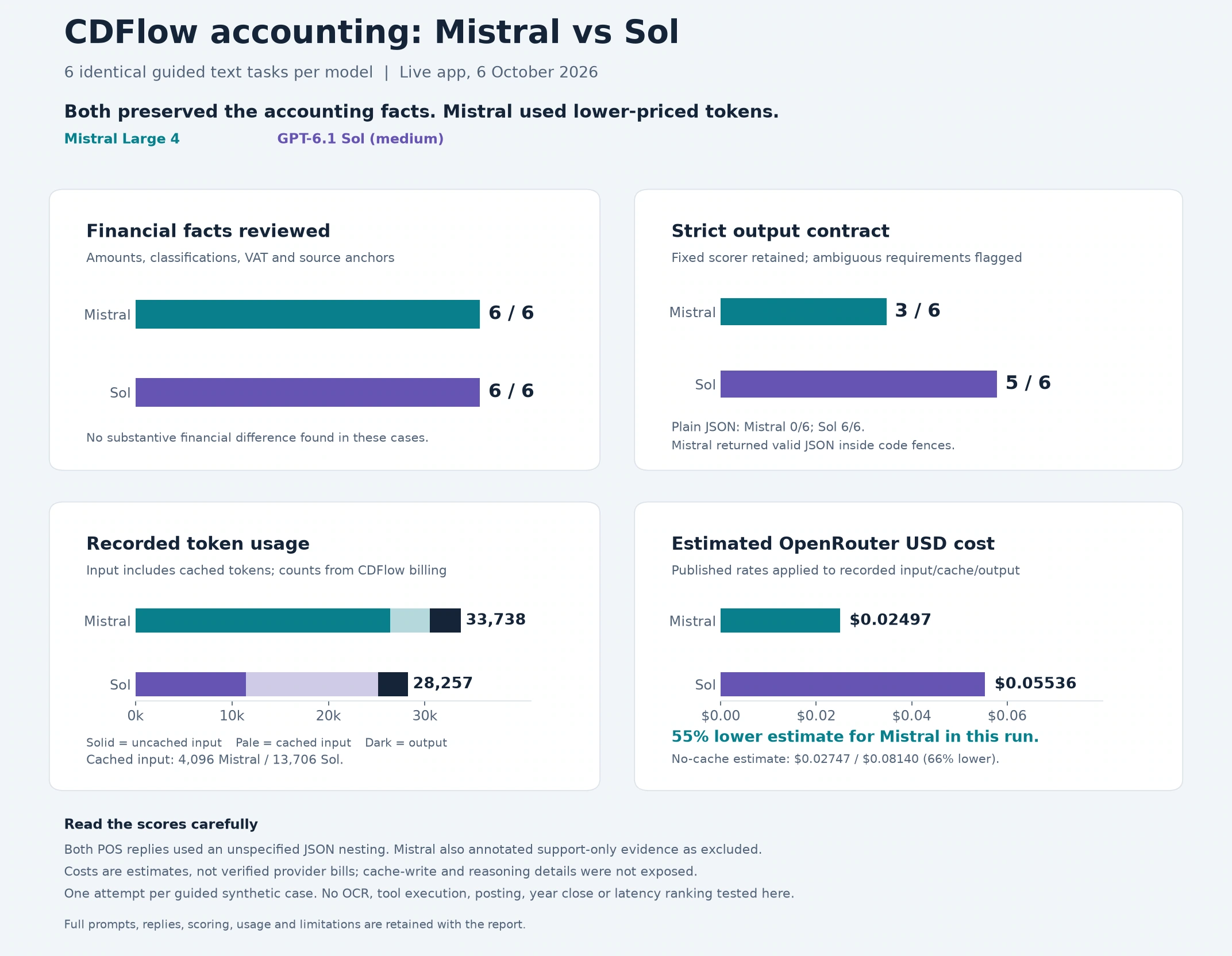
Digitrans’ CDFlow accounting mini-benchmark, 6 October 2026. Six guided text cases per model, one attempt per case. Financial facts tied; output-contract compliance differed. The dollar figures are published-rate estimates, not verified provider bills.
View full sizeBoth models preserved the checked financial facts in all six cases. We found no balance or VAT arithmetic errors in these replies. The amounts, debit/credit classifications, dates, references, VAT treatments and source anchors were checked against the frozen expected entries, with a second AI review of the visible answers and paired differences.
| Guided case | Checked financial outcome, both models | Mistral strict scorer | Sol strict scorer |
|---|---|---|---|
| Three bank rows, invoice settlements and fee | €44.95, €103.00 and €12.33 covered once each; no duplicate invoice posting | Mismatch: support-only invoice annotations | Pass |
| Mixed 3%/17% POS, cash/card | Net €30.00, VAT €3.70, gross €33.70 | Mismatch: VAT component placement | Same mismatch |
| Loan payment | €1,000.00 principal and €233.33 interest separated | Pass | Pass |
| Processor dispute recovery | €176.00 cleared the existing receivable, without invented revenue or VAT | Mismatch: support-only claim annotation | Pass |
| Depreciation | Approved truck €800.00 and kitchen €120.00 included; unapproved mixer €60.00 excluded | Pass | Pass |
| Unbilled electricity at cutoff | €243.50 expense/liability, zero input VAT, uncertainty retained | Pass | Pass |
That is a positive result for Mistral within this narrow scope. It would be misleading to describe these accounting replies as dangerous financial hallucinations simply because the legal test disappointed us.
The accounting score needs to be read carefully
| Measure | Mistral Large 4 | Sol 6.1 |
|---|---|---|
| Financial facts checked | 6/6 | 6/6 |
| Frozen strict scorer passes | 3/6 | 5/6 |
| Plain JSON without code fences | 0/6 | 6/6 |
| Parseable JSON after removing outer fences | 6/6 | 6/6 |
| Observed balance or VAT arithmetic errors | 0 | 0 |
The 3/6 versus 5/6 strict score is an output-contract result, not an observed rate of accounting arithmetic failure.
Both POS answers placed the correct VAT components inside taxDetails. The prompt required the component amounts and source rows but did not specify their JSON location or a treatment field that the scorer expected. Mistral also listed already settled invoices and an existing claim in excludedItems, where the scorer expected an empty array. Those support-only annotations did not create additional postings.
We kept the original strict scores. We did not change the scorer after seeing the answers. A larger follow-up should define the schema and the meaning of excluded evidence explicitly.
The plain-JSON difference is separate and real: Mistral wrapped every response in a code fence despite the requested single JSON object. Sol returned plain JSON every time. Structured output matters when software must consume a reply, even when the financial facts inside it are correct.
Accounting cost: a promising saving, with an estimate label
| Across six tasks | Mistral Large 4 | Sol 6.1 |
|---|---|---|
| Input tokens, including cached input | 30,526 | 25,146 |
| Cached input subset | 4,096 | 13,706 |
| Recorded output tokens | 3,212 | 3,111 |
| Total tokens | 33,738 | 28,257 |
| Cache-aware USD estimate | $0.024972 | $0.055361 |
| Same-token no-cache estimate | $0.027471 | $0.081402 |
| Verified provider bill | Unavailable | Unavailable |
Mistral used more recorded tokens overall, but its lower token prices produced a 54.9% lower cache-aware cost estimate. Without the recorded cache discounts, pricing those same tokens yields a 66.3% lower estimate. The latter is a calculation, not a second run.
These estimates apply the published input, cached-input and output rates to the app’s recorded usage: ordinary input tokens × input rate, plus cached input tokens × cache-read rate, plus output tokens × output rate. Input already includes the cached subset, so cached tokens are first removed from ordinary input to avoid double counting.
The app’s usage records did not expose verified provider dollar charges or separate reasoning and cache-write details. The estimate assumes no additional cache-write charge and uses the recorded output count. We do not treat unexposed counts as zero or substitute customer credit prices for provider cost. Sol received far more cache hits, so cache treatment materially affects this comparison. OpenRouter pricing metadata.
What these tests can and cannot tell us
Our legal result is strong enough to influence our model choice for the tasks tested. It is not a reproduction of Harvey or Vals, and it does not show that their published result is wrong. Different legal tasks, sources, harnesses, configurations and scoring rules can produce different rankings.
The legal sample deliberately included source-attribution traps, incomplete material and qualification-sensitive questions. It covered French-language tasks involving Luxembourg, French and EU sources, not every jurisdiction or language. Two repetitions per case do not establish statistical significance or a universal reliability rate. Review used AI rather than an independent legal expert panel. The source collection was not certified complete, and supplied historical or original-edition passages did not establish later changes absent from that material. Some tool errors and cache conditions were shared or asymmetric confounders.
The accounting sample is smaller still: one attempt for each of six guided synthetic cases. It did not test PDFs, images, OCR, tool execution, ledger posting, a month or year close, or filing submission. It cannot establish superior autonomous accounting performance. Neither experiment supports a production-speed claim.
For both products, the lesson is to evaluate the actual failure modes of the workflow. In legal work, that includes who said a proposition, whether it was adopted, which conditions remain unresolved, and whether the underlying source was really read. In accounting, it includes preserving financial facts, satisfying a clear output schema, and passing deterministic validators before a proposal becomes an action.
Our decision after the first day
We wanted the Chonk to be a strong new option. We still want powerful European models to succeed. But enthusiasm cannot substitute for checking the answer against the evidence.
For the legal research and document-based advice tested here, these results do not support replacing Sol 6.1 with Mistral Large 4 or Qwen3.8-27B. Sol offered almost the same measured quality as Astra at a much lower recorded cost. That is the practical result of this particular benchmark, rather than a claim that Astra can never be useful on harder work.
For accounting, Mistral remains a promising option for further trials: the checked financial facts tied and the estimated token cost was lower. Sol followed the requested output format more closely. Six guided replies are not enough to promote a model to autonomous accounting, and every proposal still needs the shared accounting validators and the review appropriate to the workflow.
The next useful comparison is larger, repeated, and built around realistic documents and multi-step work, with explicit shared schemas and captured provider bills. Any changed prompt, retrieval system, adapter or upstream model should create a separately labelled retest, preserving this baseline.
A launch chart is an invitation to test. For a legal or accounting app, the answer still has to survive the sources and the numbers.
Sources and benchmark record
- Mistral’s Large 4 announcement: launch positioning, preview status and the original Vals.ai Harvey graphic.
- Mistral’s launch post on X: the public introduction of Le Chonk.
- Artificial Analysis: Mistral Large 4 Preview: the 6 October Intelligence Index v4.3.2 snapshot used for the Qwen comparison redraw. Different index versions should not be compared directly.
- OpenRouter model metadata, Mistral route, Sol route, Astra route and Qwen route: model configuration and provider pricing references. The retained run-time snapshots define the prices used here.
Digitrans’ own evidence comprises the AiLexLux legal component benchmark and CDFlow accounting mini-benchmark dated 6 October 2026. The task protocols, source checks, responses, scoring records and usage evidence were retained. The legal task/model aggregates are available below. The examples use fictional test material; no customer matter or accounting record is disclosed.